Knowledge OS manual
Oct 2, 2026 · @Rob
The Knowledge OS distribution 1.0 contains the following:
- seven signed-ready knowledge packs, 178 blocks;
- a reading library;
- Assay 1.2, the knowledge desk, for Cloudflare;
- a trust kit: a keyring page and a command line.
Its trust model is one offline root that certifies scoped, expiring publisher keys. Find your level below and read that section; everything else is reference.
Start here
The distribution is one folder, knowledge-os-1.0. Everything in it is listed with its SHA-256 in dist-manifest.xml, which states who built the set, from what and for what. It carries a build attestation and waits for your publisher countersignature.
| Path | What it is | Who uses it |
|---|---|---|
START-HERE.md |
One page: what to open first for each level | Everyone |
library/knowledge-os-library.html |
All seven packs in one Knowledge Pool v3 page, 178 blocks, readable offline | Reader, everyone |
packs/*.pack.xml |
The seven knowledge packs, each sealed and carrying a lineage manifest | Assayer (install), publisher (sign) |
apps/assay-pages-upload.zip |
Assay 1.2 for Cloudflare Pages drag and drop: index.html, _worker.js, sqlite3.wasm |
Operator |
apps/assay-cloudflare.zip |
Assay 1.2 source, tests and wrangler.jsonc, for the Workers route and for developers |
Operator, developer |
trust/keyring.html |
The keyring: root ceremony, publisher keys, certify, sign, verify, revoke; runs offline | Publisher |
trust/kos.mjs |
The same trust kit as a command line (Node 20 or later, no install) | Publisher, developer |
trust/kos-trust.mjs |
The trust module the keyring, the command line and Assay all use | Developer |
build/ |
The scripts and sources that rebuild the packs and the library byte for byte | Developer |
CHECKSUMS.txt |
SHA-256 of every file, for sha256sum -c |
Everyone |
MANUAL.md and manual-trust-diagram.png |
This manual as Markdown, with the trust diagram as an image | Everyone |
dist-manifest.xml |
Who built the set, from what and for what; every file's size and SHA-256; build-attested, ready for your countersignature | Publisher, everyone |
library/knowledge-os-library-reader.html |
The same library with the reader features only (contents, relations, trail, comments; no export, merge or ledger), smaller | Reader |
apps/assay-standalone.html |
Assay 1.2 as one page with no server: paste sources instead of capturing them, so stamps reach VP at most; Install works | Assayer |
The seven packs:
| Pack | Blocks | Contents |
|---|---|---|
kos-review |
47 | The Knowledge OS review (28 Sep 2026), updated to 2 Oct: the spine as an operating system, the tool block, records and replay, publish and install, the extension layers, the staged plan, decisions D1–D6 |
kos-trust |
15 | The trust root decision, roles, lineage specification and install policy |
kos-systems |
11 | How Knowledge Pool v3 and Assay work: C14N-MR 1.0, the content root, the stamp rule, the pipeline, releases 1.1 and 1.2 |
kos-standards |
36 | The 25 dated standards of proof and the 11 kinds of claim with the standards that judge each |
kos-provenance |
32 | Every idea restated, oldest first: originator, first publication, where IP or priority sits, how it was checked |
kos-platform |
31 | Cloudflare, Anthropic API, web platform, SQLite and protocol facts, each dated and sourced |
kos-tools |
6 | The six Assay tool definitions as tool blocks |
Research packs, separate from the seven and not built into the library page (open them with Open files in the library or reader):
| Pack | Blocks | Contents |
|---|---|---|
kos-ucl-sts |
415 | Proof against affirmation: UCL's turn from History and Philosophy of Science to Science and Technology Studies read through Maxwell (2015), with the evidence on diagnosis, treatment and pharma. Nine governing rules, governed conflicts, refutable theses, the department's output 1966–2010, and each scholar's ethos coded and compared with Maxwell's |
kos-dsm |
260 | The DSM tested: diagnosis, drugs and evidence. 145 papers and 37 institutional records read 5 Oct 2026, including a UK diagnostics extension: the NICE pathways for psychosis (CG178, CG155) and autism (CG128, CG142), what tests can and cannot show, diagnostic stability and misdiagnosis, instrument accuracy against prevalence (computed), remission and recovery, medication effects mistaken for illness and rebound, and review and redress in England (tribunal, second-opinion doctors, advocates, Mental Health Act 2025, ICO rectification, complaints). 12 rules, 28 governed conflicts, 7 computed measures, 20 refutable theses |
kos-autism |
246 | Autism as many routes: cognition, causes, addiction and measurement. 194 records read 6–7 Oct 2026 (188 papers; Galton 1869, 1874 and 1883 and Smith 1759 read in the primary texts; SPENAM unread, HTTP 403): explicit vs spontaneous mentalising, compensation and camouflaging, predictive coding and perception, conformity, alexithymia and double empathy; genetic, prenatal and deprivation routes; heterogeneity and normative models against a single spectrum; stimulants, dopamine D2 and ADHD medication; substance use in ADHD and autism with the Dutch addiction research; alcohol and GABA; cannabis and psychosis; puberty and longitudinal imaging; why questionnaires and group means cannot diagnose an individual (computed); the history of the measures. Every evidence block checked against its record by an independent reader. 11 rules, 21 governed conflicts, 6 computed measures, 14 refutable theses |
Find your level:
- Reader: you read what others assayed. Read Level 1.
- Assayer: you check sources and claims with Assay. Read Levels 1 and 2.
- Publisher: you hold the keys and sign what is distributed. Read Level 3 and Trust at a glance.
- Operator: you deploy and run Assay on Cloudflare. Read Level 4.
- Developer: you change the formats, the packs or the code. Read Level 5 and Lineage.
Trust at a glance
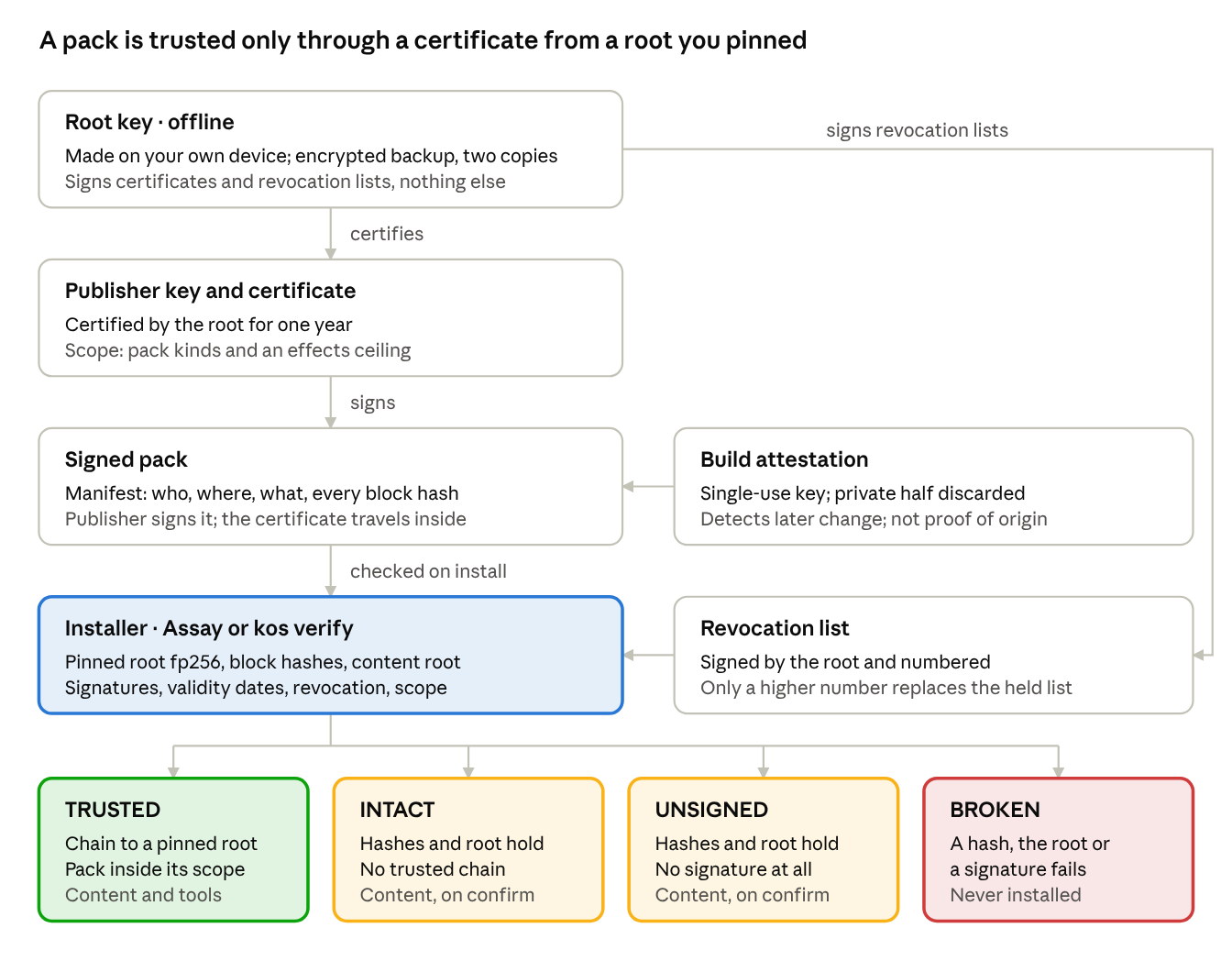
Read it top to bottom. The root signs only two things: publisher certificates and revocation lists. A publisher signs packs inside the scope its certificate grants. The installer accepts a publisher signature only when the certificate chains to a root whose full 64-hex fingerprint (fp256) you pinned. Integrity is checked first and independently of trust: an edited block, reading path, manifest statement or pack title makes a pack BROKEN whatever its signatures say. INTACT means only that the pack is consistent with itself. Anyone can re-seal edited blocks and attest the result with a fresh single-use key, so at INTACT or UNSIGNED the who / where / what statements are claims, not proof; only TRUSTED authenticates them. The <schema> element is outside every hash, and installers do not use it.
The root decision
Chosen: one offline root per organisation, scoped publisher certificates beneath it, single-use build keys. For Memeroot Ltd this is one root key, made in keyring.html on Rob's own device, stored only as a kos-key-backup-1 file (PBKDF2-HMAC-SHA256, 600,000 iterations, then AES-256-GCM) with a second copy offline. It is opened for a certification or a revocation and closed again. Daily signing uses a publisher key whose certificate expires after a year (--days, default 365) and names the pack kinds and the highest effect class it may sign.
Why this is the most secure arrangement that stays usable for one person:
- The key that is used daily is not the key that is trusted. Losing a publisher key costs one revocation list and one new certificate; no desk re-pins anything. This separation of a rarely-used offline root from online signing roles follows TUF (Samuel, Mathewson, Cappos, Dingledine, CCS 2010).
- Scope is bound to the certificate, not chosen by the pack. A content-only certificate cannot make a tools pack TRUSTED, and a pack declaring
external-writeunder anetworkceiling is refused trust. This is Bishop's recommendation after ILOVEYOU: certification combined with sandboxing, the degree of sandboxing set by the signer and bound to the certificate (Bishop, UC Davis, 9 May 2000). - A build attestation detects later change; it does not prove origin. The build signs with a key generated for that one build and then discarded, so a compromised build machine leaks no reusable key, and any change after the build breaks the attestation. Because anyone can make such a key, an attested pack is INTACT at best; origin is established only by the publisher signature. Signed per-step supply-chain attestations are in-toto (Torres-Arias et al., USENIX Security 2019); kos-trust uses only its simplest form, one step.
- Lineage continuity. The substrate's existing identities are ECDSA P-256 (
mr-identity-public-v1, for example research-assistant-tour-author, fingerprint d4a6bc6509ae27d6). kos-trust reads them unchanged under the same fingerprint rule, so the root certifies them as publishers without re-keying. That is the reason for P-256 rather than another curve.
Rejected:
| Option | Why not |
|---|---|
| A flat allowlist of publisher keys pinned in every desk (direct trust, as in PGP, Zimmermann 1991) | Every key change needs every desk re-pinned, and nothing limits what a key may sign |
| One key signing everything | A single compromise forces re-keying every installation; ceremony and daily use are not separated |
| Threshold roots (several keyholders, k-of-n, as TUF allows) | Stronger, but needs several people. The roots file already accepts more than one root, so this remains the upgrade path; thresholds are not implemented in 1.0 |
IP and priority: certificate chains are X.509 (ITU-T, 1988); ECDSA over P-256 is FIPS 186-2 (2000); offline-root role separation is TUF (2010); scope bound to the certificate is Bishop (2000). These are published, unencumbered results. What is Memeroot's is the kos-trust 1.0 formats (signed-bytes layout, certificate and manifest elements, levels) and their implementation.
Level 1 · Reader
Open library/knowledge-os-library.html in any current browser; it needs no network and no installation. It is a Knowledge Pool v3 page. The pill at the top, for example “✓ 178 sealed · 2b7f4142”, means every block was re-hashed in your browser and matches its identity. The short hash is the library's content root.
- Contents. Tick the parts you want and press Open reading path: each ticked part becomes a tab. Search, the stamp filter and the kind filter narrow the list.
- Reading as. The profile menu (Reader, Assayer, Publisher, Operator, Developer) lists the five levels. The packs do not yet score blocks per profile, so choosing one does not reorder anything.
- Relations. A block's see, restates and judged-by links take you to the block they name. restates always points into the provenance pack.
- Export. Word, PDF, Markdown and HTML copies of what you ticked. Each copy carries the identities, so a later reader can check it.
Opening files (reader and publisher pages; not the minimal reader). Press Open files, or drop files anywhere on the page. The reader takes .pack.xml packs, pool .xml files and Knowledge Pool .html pages. It reads only the pool embedded in a page, never its code.
- Under Trust roots, choose the publisher's
roots.xml. Compare the fingerprint shown with the one the publisher gave you another way, tick the box and press Pin root. Pinned roots and revocation lists are kept in this browser. - Choose or drop files. Each one is checked in the page before anything changes: block hashes, the content root, signatures, and the certificate chain to a pinned root, with its validity, revocation and scope. Each file then shows its level and its who / where / what.
- Add to this reader adds the content blocks unchanged. A key that is already taken gets a new key (
key~hash6), and the identity stays the same. The file's reading paths become new parts in Contents, and a sealedinstall-recordblock is written. The record states the level, who, where and what, and the signers, and commits to the SHA-256 of the file and of its signed manifest; the manifest itself is kept in the record's<lineage>. - INTACT and UNSIGNED files need Add as untrusted ticked first, and their record is stamped U.
- BROKEN files, tools or feature packs, and packs carrying system blocks are refused.
- Adding the same file again changes nothing.
- Added blocks live in this page until you save it from Build (Download full). The saved page reopens with them sealed.
To check a set of files in bulk, node build/kp3/v3/test-files.cjs <page.html> packs trust/kos.mjs runs 18 checks against a page in headless Chromium:
- pin a root;
- add a TRUSTED pack, then the same pack again;
- an INTACT pack, a tools pack and a tampered pack;
- a page file;
- a drop;
- save and reopen;
- no network requests and no page errors.
What the stamps mean in these packs:
| Stamp | On a fact, date or citation | On a design, rule or decision |
|---|---|---|
| VV | Checked against the primary source on the date shown | Not used |
| VP | Checked only against secondary or bibliographic records | Authored here; its provenance is this work |
| U | Stated from memory and not re-checked: confirm before you rely on it | Not used |
On a claim that Assay judged, the stamps are stricter. VV means the quote was located, appraised to its standard, and corroborated by an independent publisher's page that the desk fetched. VP means located and to standard, but without that corroboration. U is anything else.
Checking where a pack came from. Open trust/keyring.html, go to Verify, choose the publisher's roots.xml and one or more packs, and press Verify. Each pack states three things, which are authenticated only when its level is TRUSTED:
- who it is (its content root, author and builder);
- where it came from (the documents, research and sources it was derived from);
- what it will do (its kind, the effects it may have, how it installs).
It also shows a trust level: TRUSTED, INTACT, UNSIGNED or BROKEN (see Trust at a glance).
Level 2 · Assayer
Assay is the desk you check sources with. Your operator gives you its address and an access token. Enter the token once under System → Access token; the status pill then reads “Cloudflare · Claude API”. Claude proposes; the checks and a fixed stamp rule decide, so nothing Claude writes can raise a stamp by itself.
Assay a source.
- In Assay, paste a web address and press Capture. With “Extract and appraise straight after capture” ticked, the steps run in order:
- the page is fetched by the deployment, sanitised and hashed three ways;
- Claude lists its claims, each with a verbatim quote;
- every quote is located mechanically;
- each located claim is judged against the dated standard for its kind.
- Open Claims. Each row shows its stamp and verdict. Open a claim to see:
- why it has that stamp;
- the quote highlighted in the captured text;
- the standard applied, with its origin and date;
- the gaps, and what would establish the claim.
- To reach VV, press Search and corroborate on a claim. Claude proposes primary sources; the desk fetches each and locates the passage that bears on the claim, and it counts only a page from a different publisher. Any located contradiction makes the claim U and is never erased.
- Without the deployment (in the claude.ai version, or anywhere else) paste the source text instead. Pasted sources reach VP at most, because their publisher cannot be checked.
Tools for a claim or a source.
- Resolve at Crossref appears under a claim when a DOI sits near its quote. It confirms the cited work's authors, venue and date against the registry. Keep the record and it is filed with the claim. It never changes a stamp.
- Archived copy (in a source) finds the Internet Archive's closest copy: an external timestamp, never corroboration.
- Watch asks the deployment to re-check the page on a timetable.
- Tools lists all six tools. SQL queries an index of the pool, for example “Claims by stamp and verdict”.
Replay an assay (Replay frame):
| Replay | What it does | When to use it |
|---|---|---|
| Audit | Re-derives every stamp from the answers Claude gave, which are stored in the pool. No model, no network; any difference is a defect | Before you rely on or hand over an assay |
| Fresh | Asks Claude again on the same capture and lists stamps that change | To find fragile judgements |
| Drift | Fetches the page again and marks quotes no longer in it as source-changed | When a watch reports a change, or before citing an old capture |
Install a knowledge pack (Install frame):
- Your publisher gives you
roots.xmland, separately (website, README, in person), the root's 64-character fingerprint. - Choose
roots.xml, compare every character of the fingerprint shown with the published one, tick the box and press Pin root. Do this once. - Choose one or more
*.pack.xmlfiles. For each, the frame shows its level and its who / where / what, the signers and how many blocks are new. - TRUSTED packs install with Install; a tools pack shows Register definitions instead, and its definitions are compared with this build's pins. An INTACT or UNSIGNED content pack installs only if you tick “Install as untrusted content”, and its record says so. BROKEN packs are refused.
- Every install adds an install record that keeps the pack's signed manifest, plus a ledger entry. Installing the same pack again changes nothing; the frame reports it as already installed.
- When the publisher issues a revocation list, load it in the same frame. Only a list with a higher number replaces the one you hold.
Hand over your work from Export: a Knowledge Pool page (verified on opening), a Markdown report, the pool XML or the ledger.
Level 3 · Publisher
You hold the root of trust; everything you distribute is signed by a publisher key the root has certified. Use trust/keyring.html opened from your own disk. Its content security policy blocks the page's own network requests (connect-src 'none') and loads nothing from elsewhere, so keys are made and used only in that browser tab and leave only as files you save. Keep key backups outside the distribution folder; build/make_dist_manifest.py refuses to run while one is inside it. The command line trust/kos.mjs does the same work with the same formats; it reads passphrases from KOS_PASSPHRASE, never from its arguments.
Once: the root ceremony (keyring tab 1; or node trust/kos.mjs keygen --role root --name "…" --out root.backup.json, then … roots --key root.backup.json --out roots.xml).
- Turn the network off if you can, and open the keyring.
- Name the root (“Rob Anderson · Memeroot root”) and choose a passphrase of at least 12 characters that you can recall. It encrypts the backup with PBKDF2-HMAC-SHA256 at 600,000 iterations, then AES-256-GCM.
- Press Create root key. Two files are saved:
…root.backup.json(encrypted private key) androots.xml(public). - Copy the backup to two offline media kept in different places. Without it and its passphrase the root cannot be used, and nobody can recover it.
- Publish
roots.xmland the 64-character fp256 shown, in your README, on your website and in your email signature. Installers pin the root by that fingerprint.
Publisher keys (keyring tab 2; kos keygen --role publisher … then kos pubkey …). Make one for day-to-day signing. Keep its encrypted backup on your working machine and its public file anywhere.
Certify (keyring tab 3; kos certify --root … --subject … --kinds … --effects … --days 365 --out cert.xml). The certificate binds a key to a scope. Recommended scopes:
| Key | Kinds | Highest effect | Valid |
|---|---|---|---|
| Your new publisher key | content, tools | network | 1 year |
| Substrate identity 3df27085… | content | read-only | 1 year |
| Substrate identity d368c1c8… | content | read-only | 1 year |
| Substrate identity 0753a69e… | content | read-only | 1 year |
To certify a substrate identity, export its public identity from the substrate canvas (Identities → export public-only). That gives an mr-identity-public-v1 file. Choose it as the subject; the keyring checks that its 16-hex fingerprint matches its key under the substrate's own rule. Its earlier region signatures keep verifying, and anything it signs from now on chains to your root. No identity is re-keyed or retired.
Sign and distribute (keyring tab 4; kos sign --key … --cert cert.xml packs/*.pack.xml, then kos sign-dist --key … --cert cert.xml dist-manifest.xml).
- Choose your publisher backup, its certificate and the seven packs. Add
dist-manifest.xmlto countersign the whole set. - Each pack is verified before it is signed: every block hash, the content root and the build attestation. A pack that does not verify is not signed.
- Check the result with
node trust/kos.mjs verify --roots roots.xml packs/*.pack.xml(content packs TRUSTED) and… verify-dist --roots roots.xml dist-manifest.xml. - Zip the folder and send it, or publish it, beside
roots.xmland the fingerprint.
Each year. Certify the same public keys again before their certificates end, then sign the packs again. The new signature and certificate sit beside the old ones, which remain as history. A certificate that has expired no longer makes a pack TRUSTED: installers check validity on the day of install, as TUF does against freeze attacks.
When something goes wrong.
- A publisher key is lost or exposed: sign a revocation list with the root (keyring Revoke;
kos revoke --root root.backup.json --seq N --fp256 <publisher fp256> --out revocations.xml). Give it a higher number than any before it and send it to every installer. Then certify a new key and re-sign. - The root passphrase is forgotten and no backup opens: the root is gone. Create a new root, publish its fingerprint, and ask every installer to pin it and unpin the old one.
- The root is exposed: the same as above, and say so publicly; nothing signed after the exposure can be trusted.
Never put the root backup on a networked drive, in email or in a chat. Never sign with the root anything but certificates and revocation lists.
Level 4 · Operator
You run Assay 1.2 on Cloudflare. Two routes share one worker. Choose Pages if you want no tools on your machine; choose Workers if you want scheduled re-checks. The Cloudflare facts below were checked between 27 September and 2 October 2026 and are dated in the kos-platform pack.
| Pages, drag and drop | Workers, wrangler deploy |
|
|---|---|---|
| Upload | apps/assay-pages-upload.zip |
apps/assay-cloudflare.zip, unzipped |
| Tools needed | A browser | Node 20+ and Wrangler 4.45.0 or later |
| D1 store | Create it, then bind it in the dashboard | Created and linked by wrangler deploy |
| Scheduled re-checks | No: Pages has no Cron Triggers; use Server → Check now | Yes, every six hours by default |
Pages, step by step.
- In Workers & Pages → Create application, press the Pages button near the bottom: the default flow makes a Worker, and Workers do not take drag and drop for code. Then choose Drag and drop your files and upload
assay-pages-upload.zip. - Settings → Variables and Secrets: add
ANTHROPIC_API_KEYandAPP_TOKEN(a long random string), both encrypted. The API stays closed untilAPP_TOKENexists. - Optional store: open the D1 SQL database page, Create Database (for example
assay). Then in the Pages project go to Settings → Bindings → Add → D1 database, with variable nameDB. No migration step is needed. - Upload the zip again: secrets and bindings take effect on the next deployment.
- Open
https://<project>.pages.dev/api/health. Expect"version":"1.2.0","ai":trueand"store":trueif D1 is bound.
Workers, step by step. Unzip assay-cloudflare.zip and, in the assay folder:
- Run
npx wrangler secret put ANTHROPIC_API_KEY. - Run
npx wrangler secret put APP_TOKEN. - Run
npx wrangler deploy.
The included wrangler.jsonc declares a D1 binding with no id, which Wrangler creates on first deploy, and a Cron Trigger at minute 17 every six hours. To deploy from Git instead, set the Root directory to the folder holding wrangler.jsonc and leave the deploy command at its default.
Hand the desk over. Give each assayer the address and APP_TOKEN. Pin the publisher's root once in Install on each browser that installs packs; pinned roots and revocation lists are kept per browser.
Watching sources. Each watch is re-fetched on its timetable, and each check records the status, the raw hash and a text hash. A change is the cue for a drift replay. One run checks at most four watches by default (variable WATCH_BATCH, 1–6), within the Free plan's 50 subrequests and 50 D1 queries per invocation.
The store.
- Server → Save to D1 stores the pool as a new version. Versions are append-only, gzip-compressed and chunked under D1's 2 MB row limit.
- A save from a stale base is refused with HTTP 409. Of two saves from the same base, exactly one wins.
- Load re-verifies the root, the ledger chain, every capture and the stored desk state against the pool before replacing anything, then audits every source.
- These checks prove consistency, not authorship. Anyone holding the token or D1 access could write a consistent pool, so keep the token private.
Updating. Upload the new zip (Pages) or run wrangler deploy again (Workers). Browsers keep their workspaces; D1 keeps every version.
Limits to know. Fetches are capped at 3 MB of text or HTML; PDFs are not read yet. The worker refuses IP-literal, local and internal hosts and re-checks every redirect hop. Requests are same-origin only and, apart from /api/health, need the token.
Level 5 · Developer
Every artefact in the set can be rebuilt from build/ and checked by its tests. Identity throughout is C14N-MR 1.0. Three implementations agree on it: the Python reference, the TypeScript in Assay and the JavaScript in kos-trust. The pack builder asserts this on every Assay block it copies.
Formats.
| Element | Rule |
|---|---|
| Block identity | sha256: + SHA-256 of C14N-MR 1.0 with X = {signature, lineage, score, comment} and R = {id, key}. Annotations and the key can change without changing identity |
| Content root | SHA-256 over the sorted content-block hashes, a newline, then the canonical content spines. System kinds (feature, test, spec, contract) are excluded |
| Pack | A <kb-pool kind="pack"> with schema, one spine, the blocks and one <manifest> |
| Manifest | who, where and what, then list (every block key and hash); title, root and blocks attributes, all inside the signed bytes; then signatures and certificates (a certificate is signed by the root, so it is attached outside the publisher's signed bytes) |
| Signature | <signature role author fp256 name pubkey value algo timestamp>: ECDSA P-256 / SHA-256, base64 IEEE P1363. Signed bytes: C14N-MR of the parent without its signature and certificate children, then \nkos-sig-1\n + role + \n + fp256 + \n + timestamp |
| Fingerprints | fp = first 16 hex of SHA-256 over the base64 SPKI text (the substrate's rule); fp256 = all 64 |
| Certificate | <certificate serial not-before not-after> with key, scope kinds effects-max and issuer fp256, signed by the root |
| Revocations | <revocations seq issuer-fp256> with revoked fp256 reason, signed by the root |
| Distribution | <distribution> with who / where / what, then files (path, bytes, sha256), signed like a pack. verify-dist also flags any file in the folder that is not listed. The set's publisher certificate is checked for root, validity, revocation and signing time; kinds and effects ceilings apply to packs, not to the set |
Rebuild and check.
- Packs:
python3 build/build_packs.py packs. The output is byte-identical for the samecontent.py. - Build attestation:
node trust/kos.mjs attest packs/*.pack.xml. - Library:
python3 build/build_library.py packs library.content.xml, thenpython3 build/kp3/v3/build.py library.content.xml build/kp3/stage1/system.xml out publisher. - Trust tests: build fresh, unsigned packs into a scratch folder (
python3 build/build_packs.py /tmp/kos-unsigned), thencd build/trust-src && npm ci && node test-trust.mjs /tmp/kos-unsigned. The 35 checks cover tampering, forged, expired and renewed certificates, revocation, scope, the title binding and the distribution checks. Run them on unsigned packs: they add their own signatures and count them. - Assay: unzip
apps/assay-cloudflare.zip, then runbash build/build.shand its four suites (31 worker, 39 store, 74 end-to-end, 6 against workerd).
The trust tools rebuild byte for byte as well: in build/trust-src, node make-keyring.mjs writes trust/keyring.html (the template with kos-trust.mjs inlined), and npx esbuild@0.25.12 kos-cli.src.mjs --bundle --platform=node --format=esm --outfile=../../trust/kos.mjs writes the command line. Packs differ from the shipped ones only in their signatures (single-use keys and timestamps are new each time) and, if build_packs.py or content.py changed, in the build hash; content roots do not change unless content does.
The reader's file feature, kb-files, is generated: python3 build/kp3/v3/make_kb_files.py build/trust-src/kos-trust.mjs inlines the same kos-trust module into build/kp3/v3/kb-files.src.js and writes features/kb-files.js, so the reader, the keyring, the command line and Assay all verify with one implementation. Its smoke test is build/kp3/v3/test-files.cjs.
Extending.
- A new pack: add a specification to
build/content.py(name, title, address, kind, purpose, parts of blocks). Give each block a key, kind, stamp, title and dried statement, plus body, sources, tags and rels as needed. Do not use the reserved kinds feature, test, spec or contract for content. Add its derived-from lines toDERIVEDinbuild_packs.py, then rebuild, attest and have the publisher sign. - A new standard: add it to Assay's
kernel/standards.tswith its originator, date, citation and rule. Rebuild Assay, then regeneratekos-standardsfrom the running desk (the builder copies Assay's blocks so identities stay shared). - A new tool: add its definition to
kernel/tools.tsand its implementation toservices/tools.ts. For network tools, add a worker endpoint whose hosts are fixed. The build pins the new definition, and the tool appears in Tools. - A new host: write a driver (the providers module today). The kernel and the formats do not change.
Where the plan goes next. Stage 6 moves Assay's code into blocks, with React as a pinned library block; feature packs install then. Stage 8 adds PDF text with page numbers, units and statistics checks. Stage 9 adds MCP. Stage 10 adds alias spines, so every name resolves to one hash.
Lineage: who are you, where did you come from, what are you going to do
Every pack and the distribution set itself answer three questions in a signed manifest. The answers are part of the signed bytes, so they cannot be edited after signing without breaking every signature (test: a changed lineage statement breaks both signatures).
Signed is not the same as authenticated. The three answers are authenticated only when the level is TRUSTED. A build attestation alone shows that nothing changed after it was made, not who made it.
| Question | Manifest element | What it holds |
|---|---|---|
| Who are you? | <who> |
<identity root>: the pack's content root, which is its identity. <author>: the person and organisation answerable for it. <builder>: who or what compiled it, with model id where one was used |
| Where did you come from? | <where> |
<derived-from kind date>: the decisions and sources it was made from. <source href status checked> where a primary source was checked. <build tool sha256 canonical>: the build script's own hash and the canonical form used |
| What are you going to do? | <what kind effects install> |
kind: content, tools or features. effects: the highest effect class (read-only < writes-pool < network < external-write). install: how it enters a desk (merge, register). <purpose>: one sentence |
Then <list> names every block by key and hash; a block in the pack that is not listed, or listed and missing, makes the pack BROKEN.
Example: kos-trust 1.0.0, after build attestation
<manifest pack="kos-trust" title="Trust root and lineage: the signing model" version="1.0.0" format="kos-pack-1"
          created="2026-10-02T12:00:00Z" blocks="15"
          root="sha256:e5633e181e586f5ccd51a1c4dfb4d6961c4ccb133ad075422c9cb4ac02e61868">
 <who>
  <identity root="sha256:e5633e18…"/>
  <author name="Rob Anderson" org="Memeroot Ltd" role="commissioning author and publisher"/>
  <builder name="Claude" org="Anthropic" model="claude-opus-5-5"
           role="collated, checked and compiled under the author's instruction"/>
 </who>
 <where>
  <derived-from kind="decision" date="2026-10-02">Decision D1 taken under the publisher's
    instruction of 2 October 2026 (most secure yet usable)</derived-from>
  <derived-from kind="source" date="2026-05/2026-06">Memeroot substrate signing: MR-CANVAS v0.8,
    companion-region-signing, identity-tour-author (mr-identity-public-v1)</derived-from>
  <build tool="build_packs.py" sha256="sha256:6a8f4d9e…" canonical="C14N-MR 1.0"/>
 </where>
 <what kind="content" effects="read-only" install="merge">
  <purpose>Decision D1 as built: who may sign what, how a pack states who it is, where it
    came from and what it will do, and how an installer decides.</purpose>
 </what>
 <list>
  <item key="tr-decision" hash="sha256:033b4b8d…"/>
  … 14 more …
 </list>
 <signature role="build" author="9c62d74bb9c723d8" fp256="9c62d74b…" algo="ECDSA-P256-SHA256"
            timestamp="2026-10-02T12:30:10.335Z" pubkey="MFkwEwYH…" value="KWeuzjqw…"/>
</manifest>
Hashes are shortened here; the files carry them in full. A publisher signature and its <certificate> are appended after the build signature in the same way, without whitespace, so earlier signatures stay valid.
Reading it back
node kos.mjs verify kos-trust.pack.xml prints the same three answers:
  level   INTACT
  who     kos-trust 1.0.0 · root sha256:e5633e18…
          authors: Rob Anderson (Memeroot Ltd) · builders: Claude claude-opus-5-5
  where   decision: Decision D1 taken under the publisher's instruction of 2 October 2026 …
          source: Memeroot substrate signing: MR-CANVAS v0.8, companion-region-signing, …
  what    content · effects read-only · install merge
  signed  build build 2026-10-02T12:30:10.335Z ✓
  · no trust root is pinned in this installer
Assay's Install app shows the same panel before anything changes in the desk.
Lineage after installation
Installing does not strip lineage off the blocks:
- Each installed block keeps its
id(its hash). If its key is already taken by a different block, it is added underkey~hash6; the key is outside identity, so the id stays valid. - An
install-recordblock (inst-<pack>-<root8>) is written to the desk. Its summary states the level, who, where and what; its body names the publisher, certificate serial and root fingerprint; a CDATApayloadholds the whole signed manifest, signatures included;rel type="installed"points at every block it added. The record joins the desk part Installed packs. - The ledger gets an
installentry with pack, version, root, level, publisher fp256, certificate serial, trust root and derived-from lines.
So any block in a desk can be traced back: block → install record (by rel) → signed manifest → publisher certificate → root you pinned. The record itself is sealed and covered by the desk's content root.
The distribution set
dist-manifest.xml at the top of the set uses the same <who>, <where>, <what>, then <files> with each file's path, byte count and SHA-256. kos verify-dist re-hashes every file and checks the signatures, so the set as a whole has a lineage, not only its packs.
Stamps inside the blocks keep the finer grain: VV checked against the primary source on the date given; VP authored here, or checked only against secondary sources; U from memory, not checked.
Troubleshooting
Messages are quoted as the tools print them.
A pack will not verify (BROKEN)
| Message | Meaning | What to do |
|---|---|---|
<key>: identity does not match content |
A block was edited after it was sealed | Get the pack again from its source; do not re-seal it locally, which would change its identity |
<key>: not listed in the manifest |
A block was added to the pack | As above. A pack never gains blocks after signing |
<key>: listed in the manifest but missing |
A block was removed | As above |
content root recomputes to …, the manifest says … |
A reading path (spine) or the block set changed | As above |
signature by … (publisher): signature does not verify |
The manifest, its lineage text or the block list changed after signing | As above. Copying through a tool that reformats XML (pretty-printing) also causes this; transfer files byte for byte |
<file>: SHA-256 differs from the manifest (verify-dist) |
A file in the distribution set changed | Re-download the set; compare with CHECKSUMS.txt |
pack title differs from the signed manifest |
The pack's title was changed after signing (the title shown on install comes from the signed manifest) | Get the pack again from its source |
<file>: not listed in the manifest (verify-dist) |
A file was added to the set's folder | Remove it; keep your own files, keys above all, outside the set |
NOT signed <pack>: … (kos sign) |
The command line verifies each pack before signing it, and this one is BROKEN | Rebuild or re-download the pack; never sign one that does not verify |
A pack verifies but is not TRUSTED (INTACT)
| Note | Meaning | What to do |
|---|---|---|
no trust root is pinned in this installer |
This desk has no root | Pin the publisher's roots.xml (Install app: choose it under Roots file, then Pin root; on the command line, --roots roots.xml). Check its fp256 against one you received another way |
issued by a root that is not pinned (…) |
The certificate comes from a different root | Pin that root only if you trust its owner; otherwise treat the pack as untrusted |
publisher … is not certified for tools packs |
Scope: the certificate covers other kinds | The root holder issues a certificate with --kinds content,tools |
pack declares effects beyond …'s ceiling (…) |
Scope: the pack asks for more than the certificate allows | Either the pack is wrong or the certificate is; never raise a ceiling to make a pack pass without reading what it does |
certificate is not valid at … (valid … to …) |
Expired, or the device clock is wrong | Check the clock; then renew: kos certify again with the same subject, then re-sign (the renewed certificate is attached beside the old one) |
the certified key has been revoked |
The publisher key is on the current revocation list | Ask the publisher for packs signed with their new key |
publisher … carries no certificate |
Signed, but the certificate was not attached | The publisher re-signs with --cert cert.xml |
Installing
| Message | Meaning |
|---|---|
Not installed: the pack is INTACT. Confirm to install it as untrusted content. |
Content packs may be installed without a trusted signature, but only after you confirm; the install record says so |
Refused: a tools pack needs a publisher signature that chains to a pinned root. |
Tools and feature packs are never installed untrusted |
Refused: feature packs install at Stage 6, when code moves into blocks. |
Expected in 1.2 |
Refused: the pack carries system blocks (feature, test, spec or contract), which are never merged. |
A pack tried to carry kernel-level blocks; it is not a valid content pack |
| Blocks counted as “whose key is taken” | The key was taken by a different block in your desk; the new block is added as key~hash6, both kept |
this list (number N) is not newer than the one held (number M) |
Revocation lists only move forward; an older list cannot undo a revocation |
Keys and the keyring
| Message | Meaning | What to do |
|---|---|---|
use a passphrase of at least 12 characters |
Backup passphrase too short | A sentence of several words is easier to remember than a short complex one |
wrong passphrase, or the backup file is damaged |
AES-GCM authentication failed | Try the second copy. There is no recovery without the passphrase; that is the point |
identity fingerprint … does not match its public key |
The public identity file was altered | Get it again from its owner |
kos: set KOS_PASSPHRASE in the environment |
The CLI never takes passphrases as arguments, so they stay out of shell history | read -s KOS_PASSPHRASE; export KOS_PASSPHRASE |
Lost keys:
- Publisher key lost or exposed. Open the root:
kos revoke --root root.backup.json --seq <next number> --fp256 <publisher fp256> --reason key-compromise --out revocations.xml. Publish the list, certify a new publisher key, re-sign current packs. Desks keep their pinned root. - Root passphrase and both copies lost. Nothing can be certified or revoked under that root again. Make a new root, publish its
roots.xmlthrough a channel people already trust, and ask every desk to pin it and unpin the old one. Existing certificates keep working until they expire.
Running the tools
kos.mjsis a single bundled file and needs only Node 20 or later; nonpm install. Runningtest-trust.mjsor rebuildingkos.mjsneedsnpm ciinbuild/trust-src/(for@xmldom/xmldom); the Python build scripts use only the standard library.keyring.htmlmakes no network requests (its Content-Security-Policy hasconnect-src 'none'). Open it from a local file, preferably on a machine that is offline for the root ceremony.build_packs.pyneeds Python 3.6 or later (built here with 3.11) and can be run from any folder; it imports the C14N-MR reference frombuild/kp3/stage1/.
Cloudflare
| Symptom | Cause | Fix |
|---|---|---|
Cloudflare asks for a deploy command such as npx wrangler deploy |
You are on the Workers path (Git or upload with build settings) | Use assay-cloudflare.zip, which includes the Wrangler configuration, and run npx wrangler deploy from its folder; or use the Pages path below instead |
| Pages direct upload works but nothing is saved server-side | D1 is not bound | Pages → Settings → Bindings → Add → D1 database, then redeploy (bindings apply to new deployments) |
| Scheduled jobs never run on Pages | Pages has no cron triggers | Use the Workers path for scheduled work |
| A Durable Object will not deploy from Pages | Pages cannot define Durable Objects | Deploy it as a Worker and bind it |
Provenance and sources
This manual and the set
Commissioned and published by Rob Anderson (Memeroot Ltd). Collated, checked and compiled by Claude (Anthropic, model id claude-opus-5-5) under that instruction, 2 October 2026, from the research artifacts of this working session and from re-checks of primary sources. Facts about vendor platforms were checked on the dates recorded in the kos-platform pack and will go stale; the pack's stamps say which.
| Part | Made from | Stamp |
|---|---|---|
kos-review |
The Assay review: frame, runtimes, the 12 tool plans, record, publish, extension layers, Stages 5 to 10, decisions D1 to D6 | VP (authored here) |
kos-provenance |
Dated origins of the foundations, systems and trust ideas used | VV where the primary record was checked |
kos-platform |
Cloudflare, Anthropic API, web platform, SQLite, protocols | VV with check date where the primary source was read; VP or U otherwise |
kos-systems, kos-standards, kos-tools |
kos-systems: authored here from Assay's code and release records. kos-standards: Assay's 25 standard blocks copied unchanged (each id asserted equal to its reference hash) plus 11 claim-kind blocks generated from Assay's standards table. kos-tools: Assay's 6 tool blocks copied unchanged, ids asserted |
as in Assay |
kos-trust |
Decision D1 as built | VP |
kos.mjs, kos-trust.mjs, keyring.html |
Written here; kos.mjs bundles @xmldom/xmldom 0.9.12 (MIT) |
tests: 35 trust checks (test-trust.mjs); 10 keyring page checks in headless Chromium (test-keyring.cjs) |
| Assay 1.2 | Assay 1.1 plus the Install app | tests: worker 31, store 39, UI 74, workerd 6 |
Where priority lies
| Idea used | Original | Used here as |
|---|---|---|
| Canonical form before hashing | W3C Canonical XML 1.0 (Boyer, 2001) | C14N-MR 1.0, Memeroot's own canonical form; not W3C C14N |
| Canonical JSON | RFC 8785 (Rundgren, Jordan, Erdtman, 2020) | Related only; not used |
| Hash over component hashes | Merkle (patent filed 1979, US 4,309,569, expired) | The content root is a flat hash over sorted block hashes, not a tree |
| Certificate chains | X.509 (ITU-T, 1988) | kos-trust certificates: one level, root to publisher |
| ECDSA P-256 / SHA-256 | FIPS 186-2 (NIST, 2000) | All signatures |
| Offline root, separated signing roles | TUF (Samuel, Mathewson, Cappos, Dingledine, ACM CCS 2010) | Root offline; publisher and build roles |
| Signed supply-chain steps | in-toto (Torres-Arias et al., USENIX Security 2019) | One-step build attestation |
| Scope bound to the signer's certificate | Bishop, analysis of the ILOVEYOU worm (UC Davis, 9 May 2000) | Kinds and effects ceiling in the certificate |
| Slow key derivation for stored keys | PBKDF2 (RSA Laboratories, PKCS #5 v2.0, March 1999; republished as RFC 2898, Kaliski, September 2000); iteration count per OWASP | 600,000 iterations of HMAC-SHA256 |
The formats in this set (C14N-MR 1.0, kos-pack-1, kos-trust 1.0, kos-key-backup-1, the dist manifest) and the code that implements them are Memeroot's. The ideas listed above are published results; none is claimed here as invented.
Sources
- Samuel, Mathewson, Cappos, Dingledine, Survivable key compromise in software update systems, ACM CCS 2010: https://dl.acm.org/doi/10.1145/1866307.1866315
- Torres-Arias et al., in-toto: Providing farm-to-table guarantees for bits and bytes, USENIX Security 2019: https://www.usenix.org/conference/usenixsecurity19/presentation/torres-arias
- Bishop, Analysis of the ILOVEYOU worm, UC Davis, 2000: https://nob.cs.ucdavis.edu/classes/ecs155-2005-04/handouts/iloveyou.pdf
- NIST, approval of FIPS 186-2, 2000: https://csrc.nist.gov/news/2000/announcing-approval-of-fips-186-2,-digital-signatu
- OWASP Password Storage Cheat Sheet: https://cheatsheetseries.owasp.org/cheatsheets/Password_Storage_Cheat_Sheet.html
- W3C Canonical XML 1.0: https://www.w3.org/TR/2001/REC-xml-c14n-20010315
- RFC 8785, JSON Canonicalization Scheme: https://www.rfc-editor.org/rfc/rfc8785.html
- Merkle patents: https://www.ralphmerkle.com/merkleDir/patents.html
- Cloudflare Pages bindings: https://developers.cloudflare.com/pages/functions/bindings/
- Cloudflare Pages direct upload: https://developers.cloudflare.com/pages/get-started/direct-upload/
- Cloudflare Workers Builds configuration: https://developers.cloudflare.com/workers/ci-cd/builds/configuration/
- Cloudflare cron triggers: https://developers.cloudflare.com/workers/configuration/cron-triggers/
- Cloudflare D1 limits: https://developers.cloudflare.com/d1/platform/limits/
- Wrangler automatic resource provisioning (24 Oct 2025): https://developers.cloudflare.com/changelog/post/2025-10-24-automatic-resource-provisioning/
- Cloudflare community, scheduling a Pages function: https://community.cloudflare.com/t/schedule-a-cloudflare-pages-function/615507
The full list, with check dates, is in the kos-provenance and kos-platform packs.